

A few days back, a story circulated about a kid who had been attacked by a crocodile in a nearby village. These big reptiles are not notorious for killing humans in the region, because people know where they hunt, usually in larger and deeper rivers where the current is slower. It seems, however, that one ferocious individual had been creating trouble for a while in the Lubilinga River, a water curse streaming along the border of Maiko National Park. Sadly enough, it culminated in the death of a teenager going by the nickname “Showman”.
Like many others in the villages along the rivers of the Democratic Republic of the Congo, this fifteen year-old fished daily in his small dugout. Children cast small lines with even smaller hooks, catching fish at times as long as twenty centimeters, not much more. Nobody knows exactly what happened, but his father explained to me that the crocodile first bit the pirogue, which probably made him fall in the water; and although his boat was four meters long, it was very narrow and could easily capsize.
The tragic news prompted the local authorities to issue an order to hunt the beast even though the species is protected in DR Congo. The same day, the ICCN (Congolese wildlife authority) gave the go ahead to the excursion by sending two rangers. Two soldiers armed with heavy machine guns were also dispatched with the patrol team and they all started striding along the river in the zone where the animal had previously been spotted.
It was somewhat unexpected for me to be able to take part in the search for the killer. I had just made my way to Onango, the hometown of the deceased kid, to gather informations about the incident when I ran into one of the ICCN rangers whom I knew well from the headquarters in Lubutu. He led me to a house, where the FARDC soldiers and another ranger where sitting and we waited there until it came time to leave for the river. We headed into the forest, all geared up, them with guns and me with my tripod on my shoulders. It felt a bit like one of those early nineteenth century expeditions.
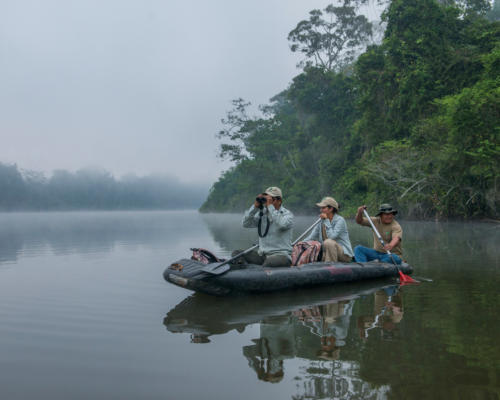
When we got to the water, large dugouts were waiting for us; we split the group into two skiffs and started a seamless navigation on the calm stream of the Lubilinga. The water regime in this season can be quite variable, but three days without rain granted us an effortless upstream journey. Scrutinizing the bushy shores for signs of crocodiles, we proceeded further up to our first halt. Each gunman was landed at a post on the shore in a still water area, scanning at the water quietly. Suddenly, one of our Gondoliers began to forcefully shake a custom-made bell (imagine a metal mug with the edges folded against each other and a stone trapped inside), I figured out that this was a trick to annoy the animal and make them move (it sure annoyed me) and I later learned that it is in fact a way to attract a crocodile,you could achieve the same effect by hitting two stones under the water's surface.
Three hours and scores of insect bites later, not a single crocodile was spotted. Patrolling at night, dawn or dusk would have been a more appropriate time to find the reptiles but it seemed like a very irresponsible and insecure thing to attempt navigation on the river on such tiny boats, when the faintest false move would have you tossed overboard.
A week after the mysterious animal had eluded all attempts of catching, frustration took the best of the authorities and a man who had had an argument with the family of the lost kid a few days prior to the incident was denounced and apprehended. Rumor had it that he would turn into a crocodile at night. This seemed like the most unlikely explanation for the boy's disappearance although one of the FARDC pointed out during my visit that he started to think those were not the deeds of an animal but of a human. Unfortunately, the investigation did not include an autopsy or even a description of the wounds of the boy, but from what had been witnessed, the kid had been bitten several times and taken back and forth to the water by the beast, finally drowning him before anyone could rescue him.
The questionable conviction of crocodile-man did not settle the problem but merely eased everybody's minds. The patrols and what would ultimately be the catch of the voracious reptile would have been a solace to the victim's family. They would have known that the park authorities would not have stuck behind conservation law (effectively protecting the animal) when a human life had been taken. Altogether, this would have helped to create a better relationship between the local people, the protected area and the wildlife authorities at times when populations are in dire need of most of the basics and often fail to understand the critical role of preserving the nature around them but above all have a hard time seeing any benefits of a conservation work that has been going for many years.
But what happened within one week after the searches were halted, no one could have foreseen. In the early hours of Saturday morning on the 10th of March, two kids who had just been assailed by a large crocodile alerted a fisherman, near a village five kilometers downstream of the previous attack. The man ran to the river with a sharpened bamboo stick and pierced the thick skin of the alligator. Wounded to the side at the level of its front leg, the animal failed to escape before more men showed up with spears and killed it. The shallow water area also gave humans the high ground and denied the aggressor a much-needed escape.
Relinquishing on their natural preys in favor of weaker targets happens with other aging predators as well. For one, old leopards like the vicinity of rural villages where they can easily snap a goat or a chicken every now and then. Those large felines even dare following hunters and identify places where they lay their traps, enjoying a facilitated meal once it is secured by the snare. The crocodile caught in the Lubilinga was old indeed, you could tell right away by looking at the broken, cracked and blunt teeth lining the border of its maul. And he had no choice but to go for slow preys, the very clumsy Homo sapiens.
The news of the slaughter spread like a wildfire. By 9 am, an enormous crowd was already clogging the dusty road behind the procession. The carnivorous was being dragged on the ground towards the town center, four injurious kilometers for the animal which once ruled over the river. Hundreds more were waiting on the main road to accompany them and before 11 am, the mass of people was so enormous that the police had to beat their way through the inhabitants of the town and surrounding villages who had gathered on the central square in order to attend the butchering and distribution of the meat of this three-and-a-half meter long beast. Here finishes the tale of a fallen king, which gave rise to endless debates about who will ultimately receive the highly prized skin, as well as the skull of this magnificent specimen.
Below, a video of the events (link).
For additional information please contact us at theforgottenparks@fzs.org
| back to overview | next post |